Goal 1

Driving Carbon Reduction Across Our Portfolios and Cities

We aim to build liveable integrated developments where technology, innovation, connectivity and sustainability converge, while minimising the negative environmental impact of these developments.

Sunway’s Net Zero Carbon Emissions by 2050 Roadmap

On Track Towards Achieving 2030 Targets

We have set future value goals and 2030 targets to drive carbon reduction across our portfolios and cities.

We have established future value goals to drive carbon reduction across our portfolios and cities.
Strategic Framework:

Decarbonisation

Resource management

Pollution management

2030 — 2050

Getting to Net Zero
By 2030, we aim to reduce our residual emissions by
0 %
We aim to achieve net zero carbon emissions by 2050 by focusing on carbon offset technology and investing in a research centre for carbon capture and utilisation.
Carbon offset will be our last resort after we have maximised other options and resources.

Implementation:

Climate Report: Net Zero by 2050

We have been disclosing our climate report, including Value at Risk disclosures, according to the TCFD recommendations since 2021. In 2025, we further assessed and aligned our climate risks and opportunities with IFRS S2.

Climate Report: Net Zero by 2050

We have been disclosing our climate report, including Value at Risk disclosures, according to the TCFD recommendations since 2021. In 2025, we further assessed and aligned our climate risks and opportunities with IFRS S2.

CO2e emissions inventory in 2025

We monitor and track our carbon footprint by collecting Scope 1, 2 and 3 data based on best emissions reporting practices.
tonnes CO2e emitted
814000
tonnes CO2e avoided
19000

Total CO2e Emissions and

Total CO2e Emissions Avoidance In 2025

Scope 1, 2 and 3

0 %
of Total CO2e Emissions

Company Vehicles

Company Vehicles

4,140 tonnes CO2e

Company Facility

Company Facility

88,434 tonnes CO2e
Scope 1:
Direct Emissions

0 %
of Total CO2e Emissions

Purchased Electricity

Purchased Electricity (National Grid)

181,180 tonnes CO2e

Scope 2:
Indirect Emissions

0 %
of Total CO2e Emissions

Category 1: Purchased goods and services

Category 1:

Purchased goods and services

354,886 tonnes CO2e

Category 4: Upstream transportation and distribution

Category 4:

Upstream transportation and distribution

1,658 tonnes CO2e

Category 5: Waste Generated in Operations

Category 5:

Waste Generated in Operations

10,379 tonnes CO2e

Category 6: Business Travel

Category 6:

Business Travel

2,801 tonnes CO2e

Category 7: Employee Commuting

Category 7:

Employee Commuting

14,677 tonnes CO2e

Category 9: Downstream transportation and distribution

Category 9:

Downstream transportation and distribution

2,110 tonnes CO2e

Category 13: Downstream Leased Assets

Category 13:

Downstream Leased Assets

50,221 tonnes CO2e

Category 15: Investments

Category 15:

Investments

103,797 tonnes CO2e

Scope 3:
Indirect Emissions

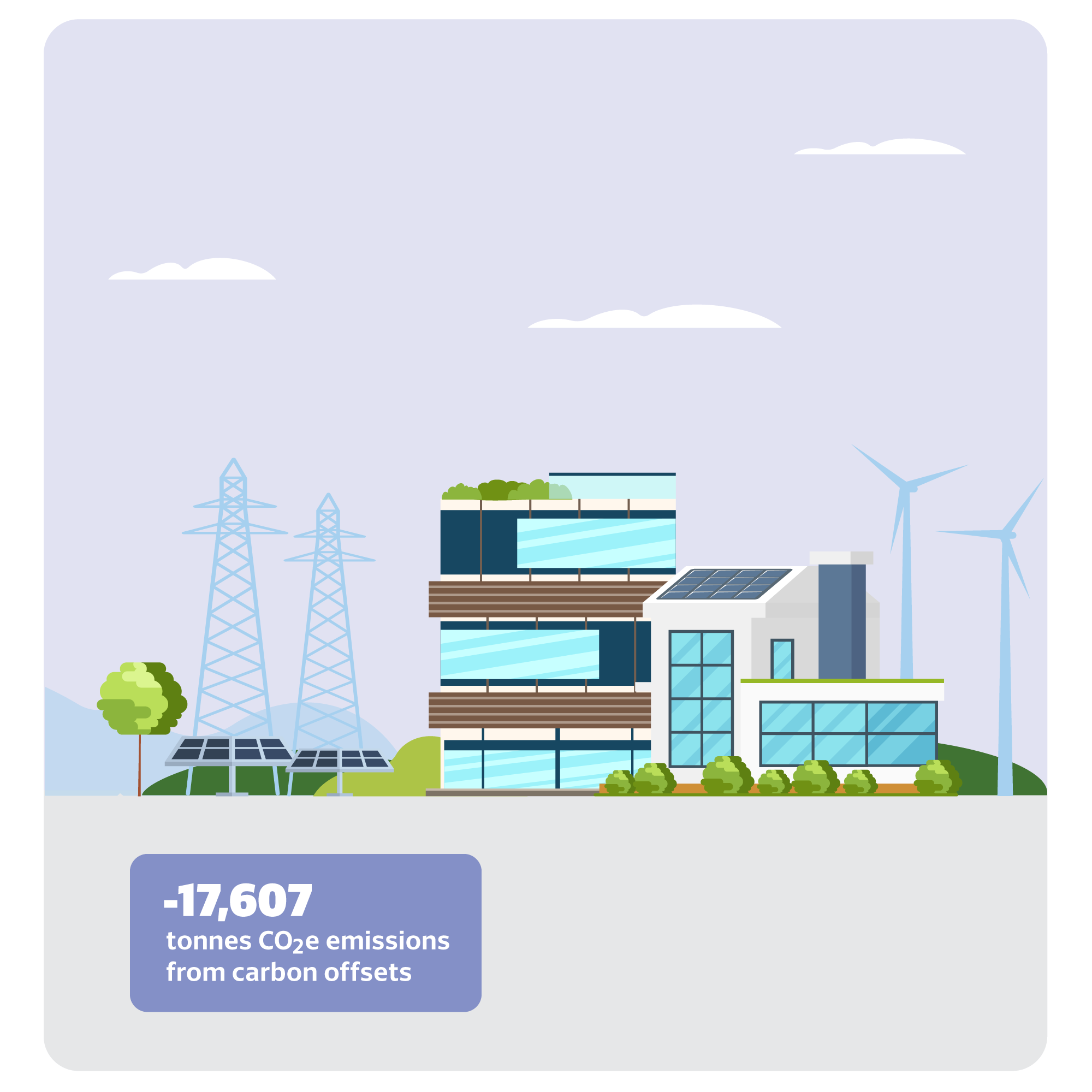
Emission Avoidance

Renewable Energy

0
tonnes CO2e Emissions
Purchased goods and services​
0
tonnes CO2e Emissions
Waste diverted ​from operations
0
tonnes CO2e Emissions
Carbon sequestrated

from 274,562 trees in Sunway Townships

0
tonnes CO2e Emissions

One tree absorbs approximately 21 kg of CO2e

Greening Our Cities and Townships

Environmental Performance Data

Our approach to lowering our greenhouse gas emissions is underpinned by efficient energy management and transitioning from fossil fuel to renewable energy.

Purchased Electricity
417000
MWh
Renewable Energy​
21000
MWh
Liquefied Petroleum Gas (LPG)
23000
MWh
Diesel
85000
MWh
Light Fuel Oil (LFO)
164000
MWh
Natural Gas
146000
MWh
Note:
Data represents 2025’s consumption

Water is an important natural resource for our business operations. To optimise water consumption and preserve this natural resource, we continue to utilise alternative sources such as rainwater and lake water for non-essential activities.

Municipal Potable Water
5851000

m3

Water Treatment Plant
112000
m3
Rainwater Harvesting
89000
m3
Groundwater
73000
m3
Lakewater
5000
m3
Note:
Data represents 2025’s consumption

Efficient waste management is a crucial part of our environmental management. Guided by the principles of a waste management hierarchy, we prioritise waste prevention and treat responsible disposal as the last resort to minimise waste generation and waste to landfill.

Disposed Waste
26000
tonnes
Diverted Waste
28000
tonnes
Scheduled Waste
Disposed Waste
1000
tonnes
Diverted Waste
0
tonnes
Construction /Industrial Waste
Disposed Waste
2000
tonnes
Diverted Waste
42000
tonnes
Note:
Data represents 2025’s generation